Earlier this month The Economist published two articles (article one, article two) on imbalances in gender. In all societies there is, at birth, a sex ratio slightly biased in favor of boys: 103-106 boys to 100 girls. The number evens out later on…
Indices are engaging and instructive, but some really baffle us. The World Economic Forum (WEF), the organisation that organises the annual high-profile Davos meetings, has come up with a gender index, and the Caucasus is featured. The index is intended to measure…
Gender issues in Armenia are currently under-evaluated and are interpreted predominantly as women’s issues. Most of the recommendations drawn from different research suggest special policies to support and reinforce women’s integration into traditionally male-dominated areas.
Women’s participation at all levels of elections in Georgia is diminishing. As the Caucasus Women’s Network (CWN)reports, women inGeorgia were less represented in terms of candidates in the last parliamentary elections than in any previous parliamentary elections inGeorgia’s democratic history. On…
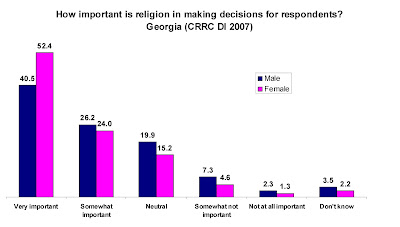
Last week we gave a snapshot of religious practices across the South Caucasus in general. The CRRC DI gives us an opportunity to explore this topic further and see whether religious practices are only country specific, or whether there are…
There has been growing concern about HIV/AIDS in the South Caucasus. But what kind of knowledge and attitudes about the disease exist in the region? By using data from the CRRC 2004 Data Initiative (DI) and conducting focus groups Gulshan Tagiyeva…