
Search Result

2164 results found.

Public Opinion in Georgia on Premarital Sex for Women

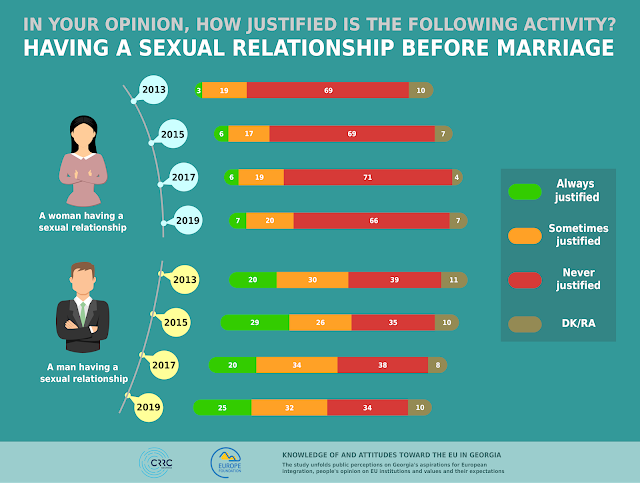
Conservative traditions are deeply rooted in Georgian society, particularly when it comes to premarital sex. The 2019 Knowledge and Attitudes towards the EU in Georgia Survey, which CRRC Georgia carried out in partnership with Europe Foundation, shows that as in the past waves of the survey, people think that it is more justified for men than women to have pre-marital sex. Between the 2017 and 2019 waves of the survey, the shares of people thinking it is justified has not changed significantly.
Conservative traditions are deeply rooted in Georgian society, particularly when it comes to premarital sex....

Supporting evidence based debate and fair elections in Georgia

The project aims to support substantive debates as part of the 2021 local elections as...

Young people are learning English in Georgia

A common sentiment when discussing foreign languages in Georgia is that young people know some English, older people know Russian, and those in between are mixed. Previous CRRC Georgia analysis from 2014 supported this claim, showing that knowledge of English was on the rise among young people. The 2019 survey on Knowledge and Attitudes towards the European Union in Georgia which CRRC Georgia carried out for Europe Foundation suggests that this trend is continuing in Georgia.
A common sentiment when discussing foreign languages in Georgia is that young people know some...

CRRC’s omnibus survey is accepting questions

CRRC Georgia is carrying out an omnibus survey in December 2019. In past rounds of the survey, researchers from the IOM and Harvard among others provided questions for the survey.

Individuals and organizations interested in adding questions to the survey are invited to get in touch about potential inclusion of questions on the survey by November 15.
CRRC Georgia is carrying out an omnibus survey in December 2019. In past rounds of...

What divides and what unites Georgian society?

The last year has seen a number of conversations about polarization in Georgia. The President of the European Council, Donald Tusk, even commented on the issue in his Batumi speech.  One of the components of polarization, though not the sole factor, is division in society over actors, issues, and institutions.

While many things could divide the public, what do the people think and which groups report more and fewer sources of division? The April 2019 NDI-CRRC poll suggests that there are fewer perceived reasons for division in rural areas and among ethnic minorities.
The last year has seen a number of conversations about polarization in Georgia. The President...

The Easterlin Paradox and Happiness U-curve in Georgia

Two of the more prominent findings from the study of happiness are that money does not buy it (up to a point) and that young and old people are happier than those in between. That money does not buy happiness is often referred to as the Easterlin Paradox. It highlights that between and within countries happiness increases with wealth, but only up to a certain point, at which increases in wealth are associated with marginal gains in happiness. That the elderly and young are happier is referred to as the happiness U-curve. This finding has been found to hold in the West, but not in the former Soviet space, where the elderly are the least happy. This blog looks at these phenomenon in Georgia.
Two of the more prominent findings from the study of happiness are that money does...

Internal Displacements’ Impact on Attitudes towards Gender Relations

As a result of the conflicts in the 1990s and in 2008 in Abkhazia and the Tskhinvali Region/South Ossetia, nearly 6 percent of Georgia’s population is internally displaced. Previous studies have suggested that internal displacement from conflict can alter attitudes towards gender relations, and specifically perceptions of women’s household authority, tolerance of domestic violence, and attitudes towards women earning money.
As a result of the conflicts in the 1990s and in 2008 in Abkhazia and...

Attitudes toward politicians are related to evaluations of institutional performance

How citizens evaluate the performance of the state is often a reasonable proxy for its performance. In Georgia, evaluations of public institutions are mixed. While a number of social and demographic variables are associated with people’s perceptions of state performance, so too are people’s attitudes towards political parties and politicians. This shows once again how politics is personalized in Georgia.
How citizens evaluate the performance of the state is often a reasonable proxy for its...