Search Result

2164 results found.

Attitudes towards the new banking regulations

The share of the public with loans from formal financial institutions doubled from 2011 to 2016 according to World Bank Group’s analysis based on Integrated Household Survey in Georgia. The July 2019 CRRC/NDI survey data suggests that about half of the population has a loan. To address perceived over-indebtedness, on 1 January, 2019 the National Bank of Georgia introduced new regulations, restricting lending without more extensive analysis of a consumer’s solvency. The analysis includes looking at an individual’s income, expenses and total obligations, and determination of debtors’ capacity to service their loans without significant financial difficulties.
The share of the public with loans from formal financial institutions doubled from 2011 to...
Knowledge of visa-free requirements falls since launch of scheme

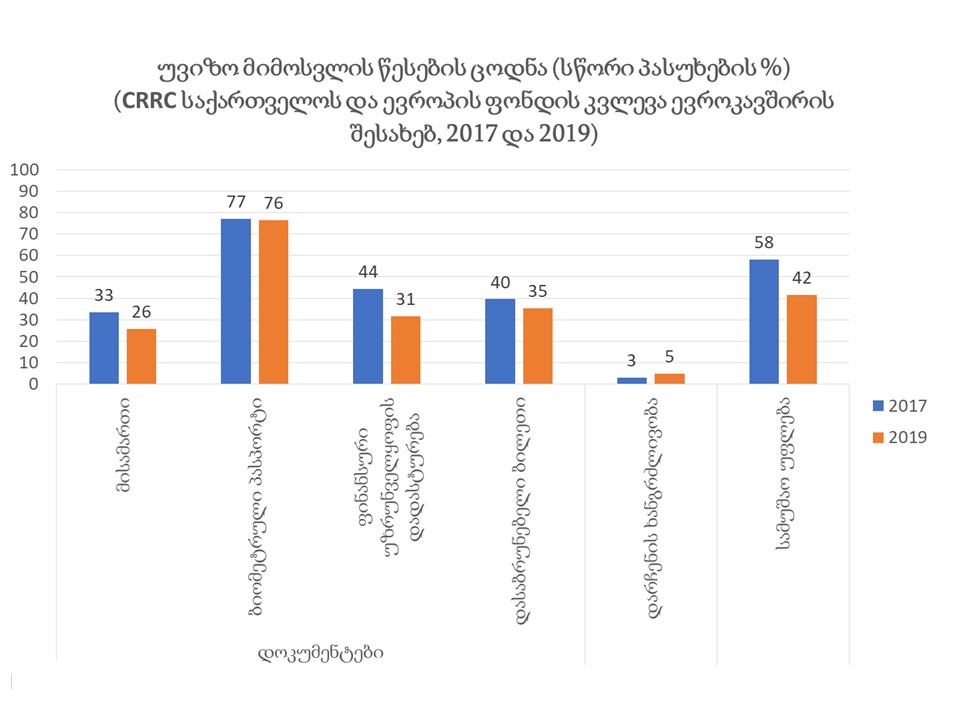
Georgian citizens have been able to travel visa free within the Schengen zone for approaching three years, the result of several years of complex dialogue and policy reform. Despite the elapsed time, and a major EU-funded public information campaign, the results of the 2019 Survey on Knowledge of and Attitudes towards the European Union in Georgia (EU Survey) suggest that public knowledge of requirements for visa free travel have fallen since the scheme launched. Similarly, the same period has seen a large rise in the number of Georgian citizens being denied entry to EU countries, with Eurostat reporting over four thousand such cases in 2018 alone, up over a third since 2017.
Georgian citizens have been able to travel visa free within the Schengen zone for approaching...

Government employees assess the work of the government better than the general public

The outlook in Georgia continues to be increasingly pessimistic, with more people reporting that the country is heading in the wrong direction. Similarly, performance assessments of government institutions have been on the decline in recent years. As recent CRRC analyses have highlighted, party identification, attitudes towards individual politicians, ethnicity, and Georgian language proficiency among ethnic minorities are associated with attitudes towards government. Analysis of the July 2019 CRRC and NDI survey suggests that working for the state is also associated with performance assessments. However, government employees in poor households and those in Tbilisi rate government performance significantly worse.
The outlook in Georgia continues to be increasingly pessimistic, with more people reporting that the...

People are divided over the independence of the Prosecutor’s Office of Georgia

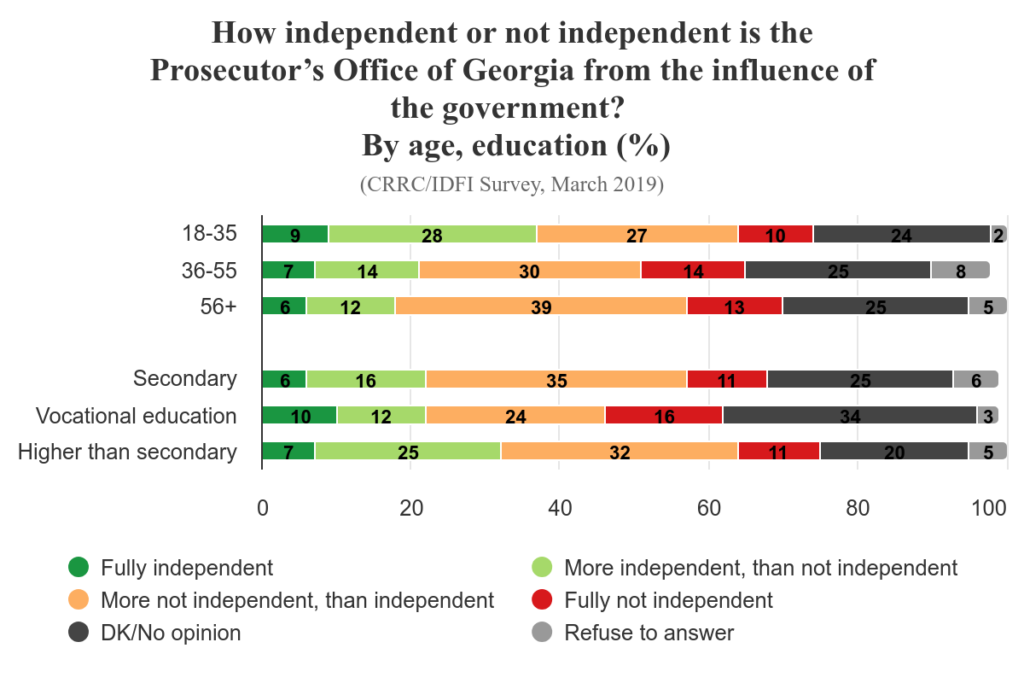
On February 23rd, 2019, Rustavi 2 broadcasted an investigation that Studio Monitor and Radio Liberty carried out titled “8 Years in Search of Justice”. The film focused on the Georgian Railway not paying a fair price to citizens when buying lands from them to build a railway bypass. The film also covered the court case about the issue. On March 7-15, 2019 CRRC-Georgia conducted a phone survey to find out whether people watched the film and what their attitudes were towards the issues raised in it. The survey also contained questions measuring attitudes towards the Prosecutors Office of Georgia (PO). The data suggest that people are divided over the PO and that those with experiences with the PO have more negative attitudes than those that have not had interactions with the PO.
On February 23rd, 2019, Rustavi 2 broadcasted an investigation that Studio Monitor and Radio Liberty...

Survey experiment: more than a quarter of people in Georgia think that Prosecutor’s Office fulfills its duties non-objectively

Several blog posts (see here and here) on Social Science in the South Caucasus have shown that the population of Georgia is split in their views of the Prosecutor’s Office (PO). In the phone survey held in March 2019, carried out for the Promoting Prosecutorial Independence through Monitoring and Engagement (PrIME) project funded by the European Union and implemented by the Institute for Development of Freedom of Information, CRRC-Georgia carried out a survey experiment to better understand under what circumstances people trust and do not trust the Prosecutor’s Office.
Several blog posts (see here and <span...

Drugs for desert? Biggest monthly household expenses in Georgia

The economy remains the main concern for people in Georgia. Together with the consumer price index and USD-GEL exchange rate rising, average household expenditures also have increased over the last couple of years. Meanwhile, according to recent data only 10% of the population has any savings. Although household expenditures have increased, what are people spending money on? The most recent CRRC-NDI survey from summer 2019 asked questions about household expenditures which provide a sense about what people spend money on in Georgia as well as who spends more on different categories of goods and services.
The economy remains the main concern for people in Georgia. Together with...

How many cars are there in Tbilisi’s streets?

People in Tbilisi often talk about the growing number of vehicles and problems associated with them. According to NDI and CRRC public opinion surveys, every third Tbilisi resident considers traffic, every fifth parking, and every other pollution among the most important public goods related issues in the city. These issues clearly relate to the cars on Tbilisi streets. Yet, a basic fact that could help inform policy to address these issues – how many cars drive on Tbilisi’s streets – is unknown, with different data sources indicating sharply different estimates.
People in Tbilisi often talk about the growing number of vehicles and problems associated with...

Selection of Supreme Court judge candidates: What people in Georgia know and think about the process

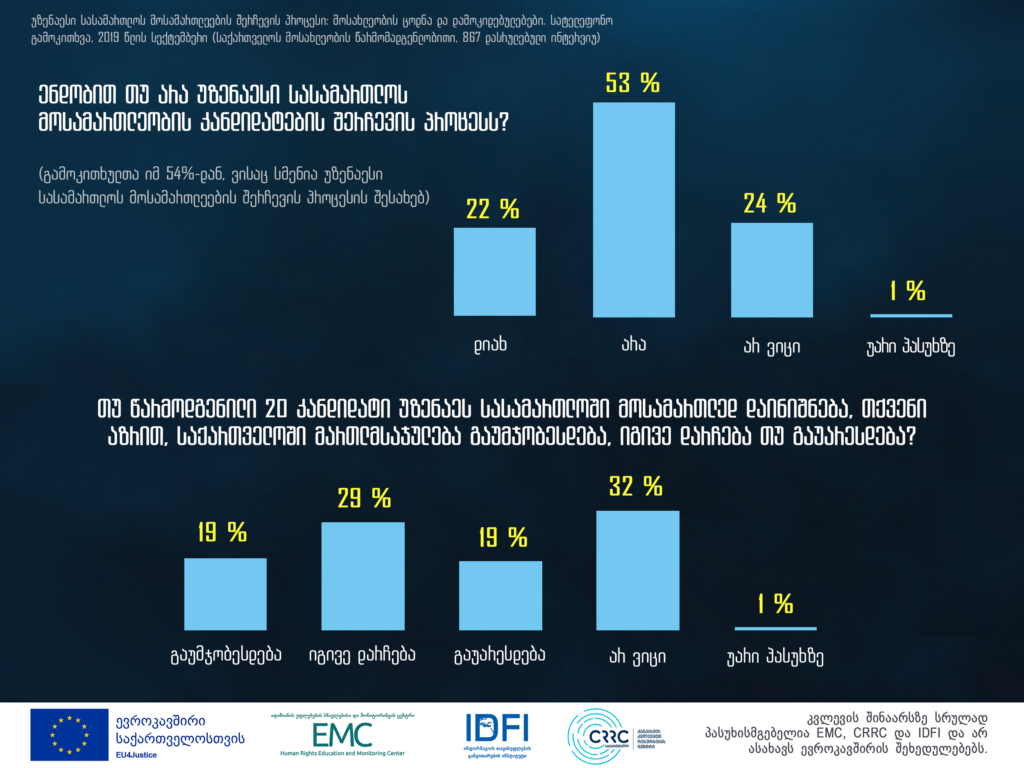
Following the constitutional amendments and changes to the organic law of Georgia on common courts, the minimum number of judges at the Supreme Court increased to 28. At the same time, 10-year appointments were changed to lifetime tenures, and the High Council of Justice was given the authority to nominate candidates for parliamentary appointment. Following these changes, the High Council of Justice started the selection of Supreme Court judge candidates and in the beginning of September 2019 provided a list of 20 candidates to be submitted to the Parliament of Georgia for approval. Interviews with candidates were live streamed and the process enjoyed wide media coverage.
Following the constitutional amendments and changes to the organic law...