Author: Mariam Kvitsiani, Tbilisi State University
Note: This blog post is based on an article prepared for the Caucasus Analytical Digest (CAD) as a joint effort of CRRC and UN Women. This post was written by Dr. Mariam Kvitsiani, researcher at Ivane Javakhishvili Tbilisi State University. The views expressed in this post are the author’s alone and do not necessarily reflect the views of CRRC, UN Women, or any related entity.
Data from the 2020–2021 Georgia Time Use Survey (GTUS) shows that even when couples are at home together, women spend most of their time doing unpaid domestic and care work, while men mostly engage in leisure activities. The study reveals that co-presence does not translate into co-participation — for many Georgian couples, “shared time” often means women working while men rest.
Unequal time in equal spaces
The study analysed diary data from 1,441 Georgian couples, focusing specifically on periods when both partners were at home. The results paint a familiar picture in a new light.
Even when couples are at home together, men and women spend that shared time in very different ways.
Men’s shared time is dominated by leisure – nearly 45% of their home hours are spent watching TV, relaxing, or engaging in personal activities. Women’s shared time, by contrast, is largely absorbed by domestic and care work – about 29% in domestic chores and another 7% in caregiving.
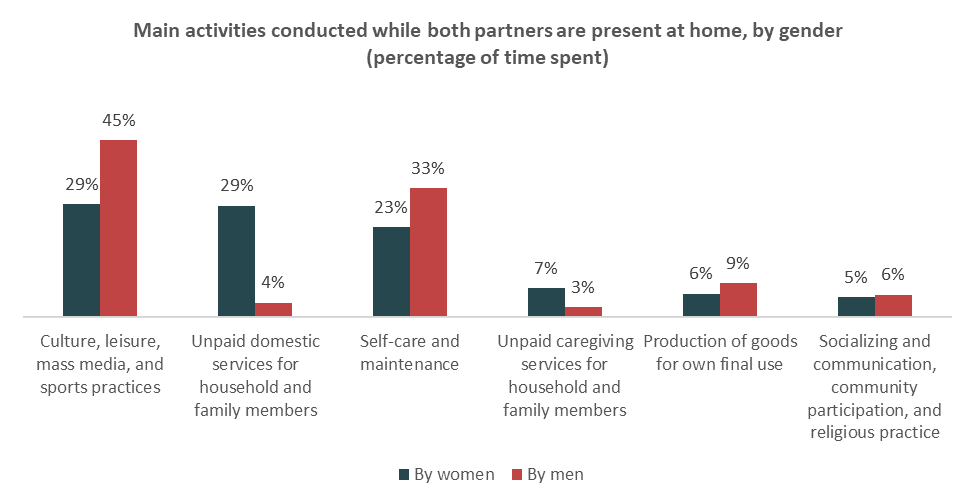
In other words, even during moments of co-presence, the traditional division of labour persists. The assumption that men do less housework simply because they are away at work does not hold up once both partners are at home.
The illusion of “togetherness”
Looking more closely at what happens when both partners are simultaneously at home provides a compelling image of everyday inequality.
While women are cooking, cleaning, or managing household tasks, men are most often relaxing — in 45% of these time slots, women’s unpaid work coincides with men’s leisure. Only in 7% of cases do men also report doing domestic work at the same time.
This pattern repeats in caregiving. When women are engaged in unpaid caregiving activities, men are again usually busy with leisure or social activities. The result is what researchers call an illusion of togetherness — couples may be in the same room, but their experiences of that shared time differ greatly.
| Cross-tabulation of Partners’ Simultaneous Activities during Shared Time, by gender (percentage of time spent) | |||||
| Female partner’s (…) | Male partner’s (…) | ||||
| Domestic | Caregiving | Socializing | Leisure | Self-care | |
| Domestic | 6.9% | 2.3% | 5.5% | 45.2% | 28.3% |
| Caregiving | 2.4% | 12.3% | 7.3% | 39.8% | 30.7% |
| Socializing | 3.7% | 2.0% | 27.5% | 41.2% | 20.9% |
| Leisure | 2.2% | 1.7% | 4.5% | 68.7% | 18.0% |
| Self-care | 2.2% | 1.5% | 3.3% | 23.4% | 64.5% |
Interestingly, the only activity where men and women’s time aligns is during leisure itself. When women report watching TV or relaxing, their partners do so too in nearly 69% of cases. True “shared time”, it seems, appears mostly when both can rest — typically after women have already completed the bulk of household labour.
Co-presence does not mean co-participation
The Georgian household remains at a stage where deep-seated gender norms play out daily. Physical proximity does not translate into shared responsibility. Rather, it often reinforces traditional roles: Women continue to engage in unpaid labour while men enjoy restorative time.
The findings highlight how gender inequality operates not only through the amount of time spent on housework but through how that time is experienced together.
Why it matters
This imbalance has broader implications. Women’s “time poverty” — the chronic shortage of free or rest time — restricts opportunities for education, employment, and personal development. It also affects family well-being and national productivity.
Policies alone cannot solve this disparity. While paternity leave, childcare services, and flexible work can help, meaningful change depends on shifting the social norms that frame housework as “women’s work”. As long as co-presence does not mean co-participation, gender equality in the private sphere will remain elusive.
About the data: The findings are based on the Georgia Time Use Survey (GTUS), covering 1,441 couples who reported being at home while their partners were also at home. The study analysed this co-present time to reveal gendered patterns in unpaid labour and leisure time.