Author: Natia Sordia, Tbilisi State University
Note: This blog post is based on an article prepared for the Caucasus Analytical Digest (CAD) as a joint effort of CRRC and UN Women. This post was written by Dr. Natia Sordia, a psychologist affiliated with Ivane Javakhishvili Tbilisi State University. The views expressed in this post are the author’s alone and do not necessarily reflect the views of CRRC, UN Women, or any related entity.
We often think of leisure as our free time – a chance to relax, connect with friends, explore, and recharge. Yet in practice, leisure time is not evenly distributed across society. Leisure may seem like a private choice, but data from the 2020–2021 Georgia Time Use Survey suggests that it is shaped by broader factors. This study analysed 5,599 adults in Georgia with no underage children in their household. Simple questions like “Who gets to rest?” and “How do they spend their free time?” turn out to be strongly influenced by gender, age, or place of residence in Georgia.
Are men’s and women’s leisure patterns the same in amount and type?
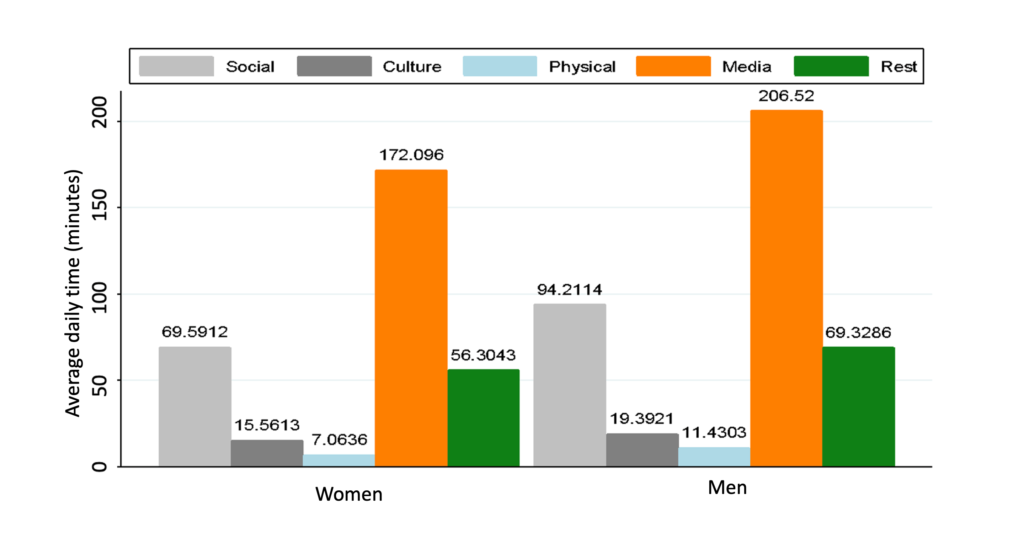
On average, men report about 6 hours and 41 minutes of leisure time per day, while women report around 5 hours and 21 minutes – a difference of roughly 1 hour and 20 minutes. This gap exists across all major activity types (whether leisure time is spent on socializing, cultural or physical activities, media use, or rest). In other words, even without children in the household, women and men experience leisure differently. These patterns reflect broader inequalities that cannot be explained solely by childcare duties or related social expectations.
Average daily time spent on leisure activities, by gender and activity type (minutes)
How does partnership status affect leisure time?
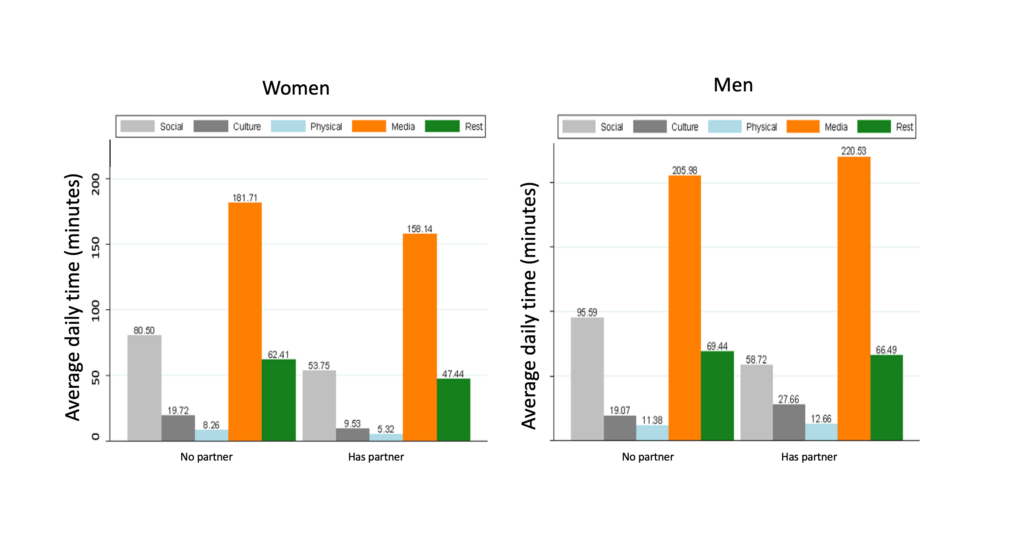
For men, having a partner increases the overall amount of time that they spend on leisure (by about 69 minutes), but leisure time spent on socializing decreases. In contrast, for women, having a partner is consistently associated with significantly less time spent on their social life, culture, physical activity, media use, and rest.
Average daily time spent on leisure activities, by gender and partnership status (minutes)
Does the picture change with age?
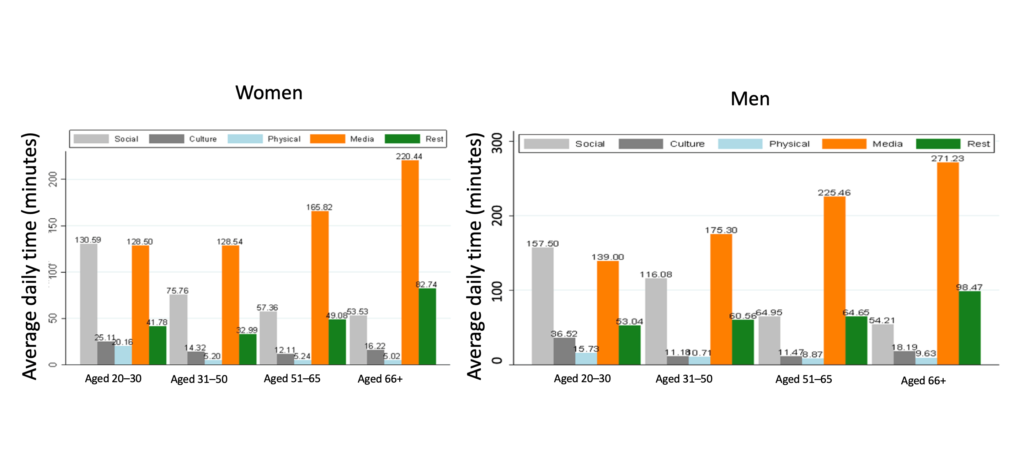
The study shows that older adults (aged 66 and above) have more total leisure time, but much of it is passive – spent on media use and rest rather than on active social or physical activities. The trends are similar for both genders.
Average daily time spent on leisure activities, by gender and age group (minutes)
Is settlement type a factor?
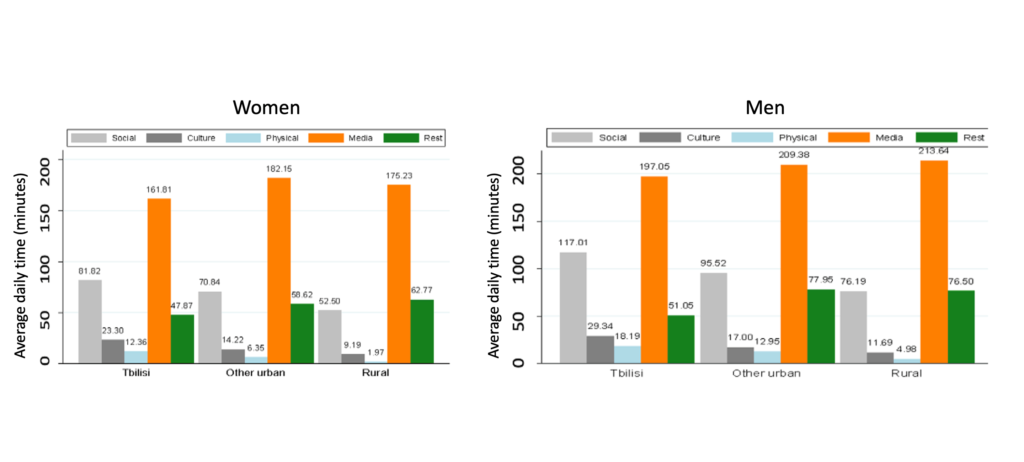
Besides gender and age, it seems like the place we live could also influence how we spend our time. Rural residents, both men and women, report less leisure time overall and are less involved in active or social leisure activities. Their free time is more likely to be passive and home-based.
Average daily time spent on leisure activities, by gender and settlement type (minutes)
Why does leisure time matter at all?
Leisure is more than a luxury – it is a key part of our quality of life. In Georgia, however, access to free time and the ways it is spent seem to vary sharply by gender, age, and place of residence. Men tend to have more active leisure than women; older adults have more total leisure time but often spend it more passively; and rural residents of all ages report less leisure time overall and fewer hours spent on social or other active forms of leisure.
These patterns suggest that equality in leisure – and in the right to rest – goes beyond childcare duties and related gendered expectations. It reflects broader social and structural differences that shape daily life. We should ask: Who gets to rest? Who gets to play? Who gets to choose how they spend their time?
Addressing these questions can open new frontiers for social policy and well-being in Georgia, making free time truly free for everyone.