Author: Salome Dumbadze, Georgian Institute of Public Affairs
Note: This blog post is based on the article prepared for the Caucasus Analytical Digest (CAD) as a joint effort of CRRC and UN Women and conducted with the support of the UN Women project “Women’s Increased Leadership for Democracy in Georgia” (WILD) and the Swiss Agency for Development and Cooperation (SDC). This post was written by Salome Dumbadze, Academic Assistant at the Georgian Institute of Public Affairs. The views expressed in this post are the author’s alone and do not necessarily reflect the views of CRRC, UN Women, the SDC, or any related entity.
Equal work, unequal time
A common assumption is that gender inequalities in time use might stem from differences in employment status, with unemployed women taking on a greater share of caregiving and domestic responsibilities while employed men engage in full-time paid work. However, findings from the 2020–2021 Georgia Time Use Survey suggest that these disparities persist even among full-time employed men and women, both in time allocation and in perceived time pressure.
A gender gap in feeling rushed
Psychologists describe chronic time pressure as both an awareness of the limited time and an emotional sense of being rushed – a state marked by worry, frustration, and anxiety (Denovan et al., 2017). Living this way is associated with increased stress, blurred focus, decreased mental and physical health (Craig and Brown, 2016; Cha and Papastefanou, 2020; Sussman and Sekuler, 2022; Löchner, Ulrich and Lux, 2024).
Among full-time employees, nearly 45% of women report always feeling rushed, compared to 34% of men. The rest (about 55% of women and 66% of men) say they feel rushed only sometimes or never.
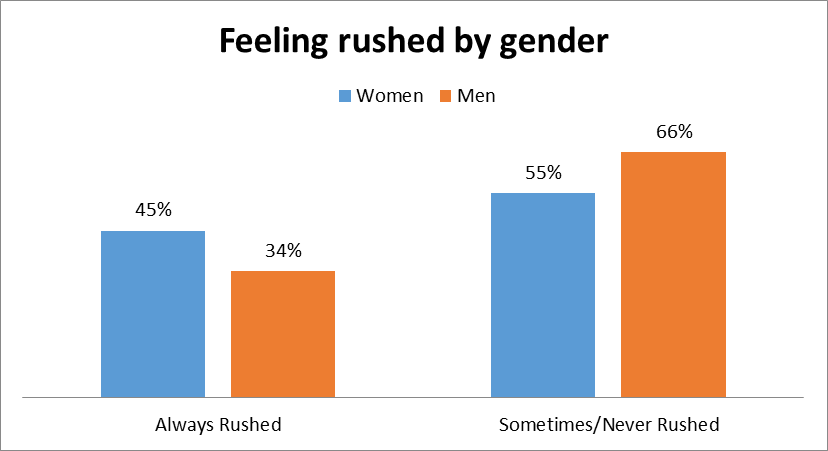
One might be tempted to explain these findings by saying that some women are simply “more emotionally sensitive”, but the data shows a different pattern. At first glance, women did seem more likely to feel rushed, but once differences in how time was actually spent on duties and restorative activities were considered, statistically significant gender difference disappeared. Therefore, women’s greater number of reports of feeling rushed turned out to be unrelated to gender characteristics, but reflected an actual unequal distribution of time. Even though feeling rushed and time allocation seem to be inter-connected, we can’t determine for sure which is the cause is and which is the effect.
How time use is related to time pressure
According to the data even with the same employment status, daily time use still differs between men and women:
- Full-time employed men devote more time to leisure and paid work than women.
- Full-time employed women spend more time on unpaid household work and caretaking tasks than men.
- Both men and women spend a similar amount of time on personal care (such as sleeping and eating) during weekdays, though women spend slightly more time on such activities on weekends.
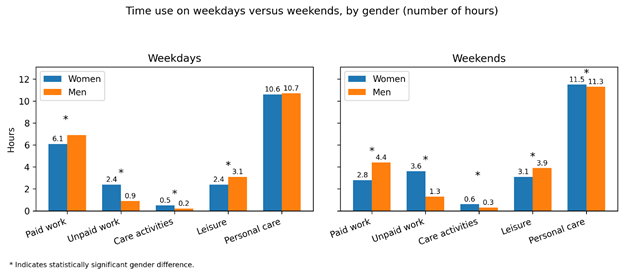
When linked to how rushed people feel in association to time use in hours, distinct patterns emerged:
- For women: Having more leisure time (both on weekdays and weekends) was associated with feeling less rushed. Although, perceived time pressure was not associated with other paid or unpaid activities.
- For men: On weekends more leisure, (surprisingly) more paid work, and more personal care was associated with feeling less rushed. On weekdays, no activity showed a strong link with feeling rushed.
Conclusion
Among Georgia’s full-time employees, women have less leisure time and more unpaid duties, while men spend more time in both paid work and leisure. These differences echo the gap in how rushed people feel, suggesting that it is the rhythm of daily life (and not gender itself) that shapes how time is experienced.
For working women, having more leisure time (both on weekdays and weekends) was linked with feeling less rushed, while other daily activities showed no relationship. For working men, time use mattered mainly on weekends: more paid work, leisure, and personal care were each tied to feeling less time pressure.
Equal employment status does not automatically mean equal distribution of time. Real balance requires fair access to rest, leisure, and recovery.
The data and appendix for this study can be accessed at https://github.com/sdumbadze/gender-timepressure-appendix.
References
Cha, S. and Papastefanou, G. (2020) ‘Understanding the time pressure of working parents: How parents’ childcare time impacts the diurnal organization of activities and the sense of feeling rushed’, Journal of Comparative Family Studies, 51(1), pp. 110–130. doi:10.3138/jcfs.51.1.006.
Craig, L. and Brown, J. E. (2016) ‘Feeling rushed: Gendered time quality, work hours, nonstandard work schedules, and spousal crossover’, Journal of Marriage and Family, 79(1), pp. 225–242. doi:10.1111/jomf.12320.
Denovan, A. and Dagnall, N. (2019) ‘Development and evaluation of the chronic time pressure inventory’, Frontiers in Psychology, 10, 2717. doi:10.3389/fpsyg.2019.02717.
Denovan, A., Dagnall, N., Dhingra, K. and Grogan, S. (2017) ‘Evaluating the Perceived Stress Scale among UK university students: Implications for stress measurement and management’, Studies in Higher Education, 44(1), pp. 120–133. doi:10.1080/03075079.2017.1340445.
Löchner, J., Ulrich, S. M. and Lux, U. (2024) ‘The impact of parents’ stress on parents’ and young childrens’ mental health—Short‐ and long‐term effects of risk and resilience factors in families with children aged 0–3 in a representative sample’, Stress and Health, 40(4). doi:10.1002/smi.3400.
Sussman, R. F. and Sekuler, R. (2022) ‘Feeling rushed? Perceived time pressure impacts executive function and stress’, Acta Psychologica, 229, 103702. doi:10.1016/j.actpsy.2022.103702.