Author: Iza Kasrelishvili, Center for the Rule of Law
Note: This blog post is based on an article prepared for the Caucasus Analytical Digest (CAD) as a joint effort of CRRC and UN Women. This post was written by Iza Kasrelishvili, a human rights lawyer focusing on gender equality. The views expressed in this post are the author’s alone and do not necessarily reflect the views of CRRC, UN Women, or any related entity.
Who looks after children in Georgia — and how much time do parents actually spend doing it?
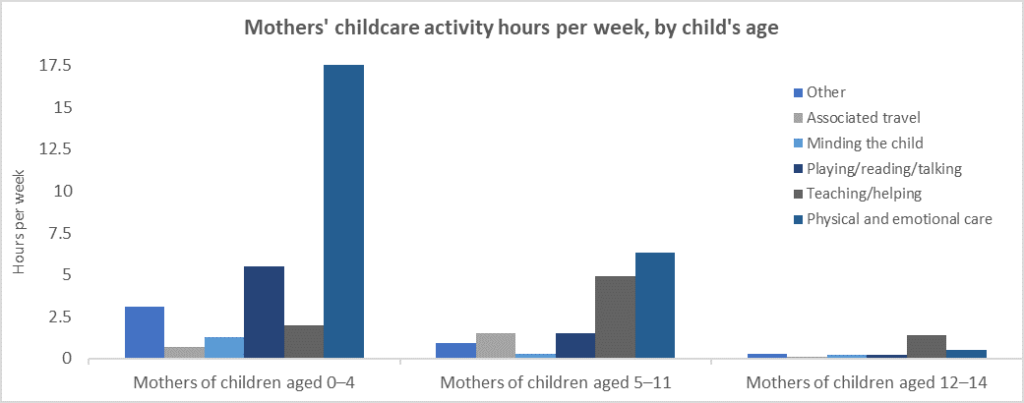
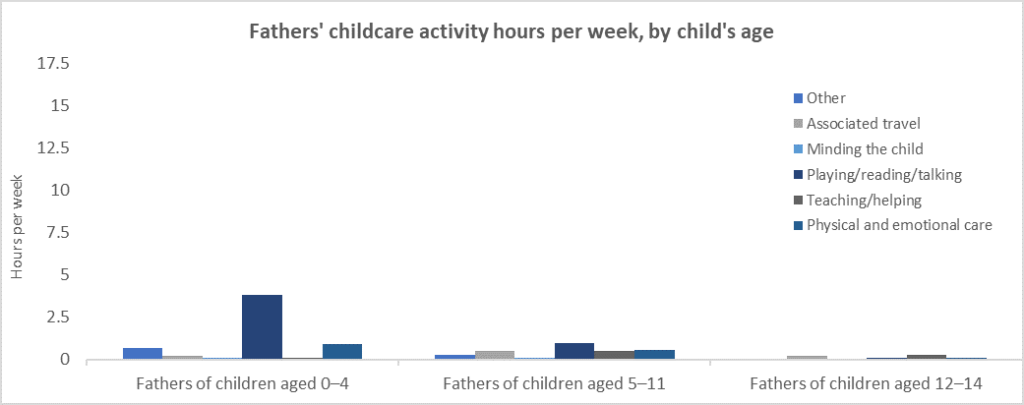
Data from the 2020–2021 Georgia Time Use Survey (GTUS) provides a revealing snapshot: Mothers spend five times more time on childcare than fathers. While 80% of mothers report daily involvement in childcare activities, only 37.6% of fathers do. The difference is not just in the amount of time but also in the type of care provided.
Patterns of paternal engagement
The GTUS shows that fathers’ participation is concentrated almost entirely in play and leisure-related interaction. They read, talk, or play with their children — but are rarely involved in tasks such as feeding, putting children to bed, helping with schoolwork, or providing emotional comfort.
Mothers, meanwhile, cover the full spectrum of childcare: physical care, teaching, supervision, and emotional support. They are responsible not only for ensuring children’s basic needs but also for fostering their cognitive and emotional development.
This imbalance begins early. For children aged 0–4 years, mothers spend an average of 17.6 hours per week on physical and emotional care, compared to fathers’ 3.8 hours — most of which is playtime. As children grow, fathers’ involvement increases only slightly and remains focused on recreational activities.
The ripple effects of unequal care
The unequal distribution of care has ripple effects. While further research is needed to explore these dynamics in the Georgian context, it can be assumed that mothers’ greater time obligations often translate into fewer opportunities for rest, professional advancement, and personal growth. Fathers, meanwhile, may miss out on the emotional closeness and everyday learning that active caregiving brings.
International research suggests that children tend to benefit most when both parents are engaged in nurturing — not just play. Shared caregiving is associated with stronger family bonds, improved social and cognitive development in children, and greater gender equality both at home and at work.
Looking ahead: From evidence to action
In Georgia, structural and cultural barriers still keep fathers at the margins of care. There is no dedicated paternity leave or flexible work policy, and childcare services for children under 2 years of age remain scarce — especially in rural areas. At the same time, nearly half of men and women believe that childcare is primarily a mother’s responsibility, and many men are concerned with possible social stigma for taking leave.
While these findings reveal clear patterns of inequality, deeper, context-specific studies could help clarify which policy tools — from parental leave design to community-based initiatives — would best address the imbalance in caregiving roles in Georgia.
What is already clear is that encouraging fathers to participate more fully in daily care requires both policy reform and a gradual shift in social norms. Expanding early childcare services, introducing dedicated paternity leave, and highlighting positive examples of active fatherhood could all help redefine what it means to be a parent.
Ultimately, this issue is not only a question of fairness between mothers and fathers — it is an essential investment in children’s well-being. Actively supporting shared caregiving means giving every child the best possible start in life.