Search Result

2169 results found.

Analysis | Georgia has a vaccine misinformation problem

Many experts believe that to fully remove the restrictions which have emerged because of the COVID-19 crisis, a vaccine is needed. While vaccines are only expected in the medium term, if and when they are available, Georgia may face large challenges with implementing a large scale vaccination program. 

Many experts believe that to fully remove the restrictions which have emerged because of the...
Covid-19 Monitor: New Report on Georgian Public Opinion on the Covid-19 Crisis

Today, CRRC Georgia released a report on public opinion in Georgia on the Covid-19 crisis. The report includes data collected between late April and early June, 2020. During this time, CRRC Georgia conducted weekly public opinion surveys and presented the results on a weekly basis to policy makers, local NGOs and the international community.
Today, CRRC Georgia released a report on public opinion in Georgia on the Covid-19 crisis....

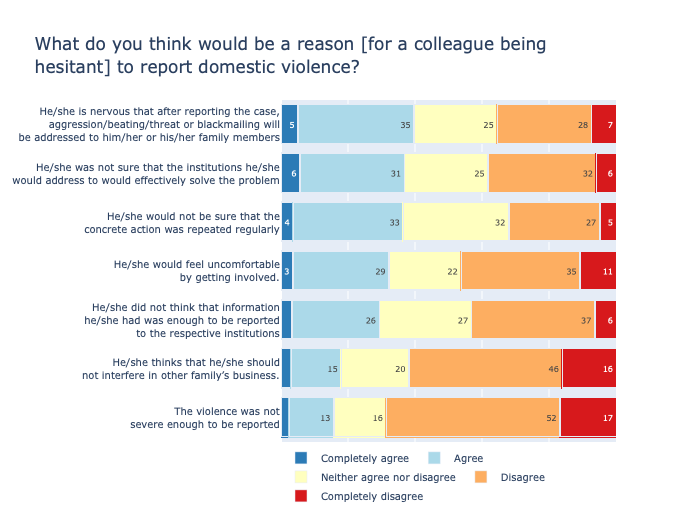
Teachers can be encouraged to report domestic violence – but the authorities must respond

Domestic violence was widely suspected to have increased during the COVID-19 crisis. 
 
A study CRRC Georgia conducted for UN Women prior to the crisis found a behavioural lever that could encourage teachers to report domestic violence they suspect among their students. Yet, the report suggests that until the government reforms the currently dysfunctional reporting infrastructure, encouraging teachers to report could do more harm than good.
Domestic violence was widely suspected to have increased during the COVID-19 crisis. 
 
...

Parental labor migration and educational attainment in Kyrgyzstan: An analysis of the data from the National Assessment of Educational Achievement

CRRC, ARISC and American Councils are proud to present the 16th and final session of the 2020 Spring/Summer Series of the Tbilisi Works-in-Progress series, now celebrating its 10th year!
CRRC, ARISC and American Councils are proud to present the 16th and final session of...

Social capital in Georgia: how trust becomes solidified when words are backed up with deeds

Social capital is a set of networks between individuals and groups of individuals and the mutual trust related to these networks. It facilitates communication and cooperation between people and makes available resources that would be otherwise out of reach. Thus, social capital is crucial for social and economic development. Caucasus Barometer 2019 data shows that while the level of structural and cognitive social capital in Georgia is somewhat low, with the cognitive component lagging further behind, the bonds between the two are strong and stronger than each’s link to other factors.
 
Social capital is a set of networks between individuals and...

Georgians’ perceptions about equality at court

Attitudes toward the judicial system have been one of the most discussed and researched topics in Georgia. CRRC’s past blogs have shown that Georgians’ perceptions of court system fairness have been at low levels throughout the last decade and that attitudes toward court system (im)partiality are associated with rates of  trust toward the court system and people working in the court system. A recent CRRC study also highlighted division among the public regarding trust in judicial institutions. This blog post contributes to this conversation through describing views on the fairness of courts in Georgia, showing its broader inter-relations with trust in institutions, political views, and general perceptions of the government’s treatment of citizens.
Attitudes toward the judicial system have been one of the most discussed and researched topics...

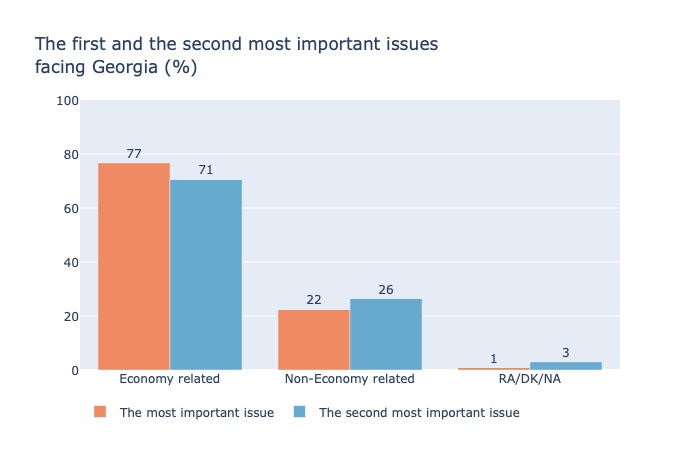
The most important issues facing Georgia, prior to the COVID-19 outbreak

What did Georgians think was the most important issue facing the country prior to the COVID-19 outbreak? The economy. The current COVID-19 outbreak will shift perceptions surely. Yet, the measures to fight the virus have slowed down the economy, exacerbating the previously existing economic issues. While the economy has consistently been the most important issue for most Georgians in recent years, this headline figure hides some nuance. This blog explores this nuance, looking at who names a mixture of economic and non-economic issues as the most important ones facing the country.
 
What did Georgians think was the most important issue facing the country prior to the...

Coming Together and Growing Apart: A Decade of Transformation in the South Caucasus – The 6th CRRC Methods Conference 2020

The last decade has seen broad political, economic, and social changes across the South Caucasus. In the previous ten years, events including Armenia’s 2018 ‘Velvet Revolution,’ the 2016 ‘Four-Day War’ in Nagorno-Karabakh, the region’s first ballot box-driven change in government in the 2012 Georgian parliamentary elections, the devaluation of the national currency in Azerbaijan, and volatility in relations between the European Union and Russia have reshaped the region. Such events have raised questions as to whether the three nations of the South Caucasus are growing increasingly apart, and if so, whether these changes reflect substantial divergence among societies or if they are simply an outcome of the interests of national elites.
The last decade has seen broad political, economic, and social changes across the South Caucasus....