Author: Marika Vacharidze, organization Bright Future
In democratic states, the protection of consumer rights is one of the key social and legal priorities. Relevant European Union directives emphasize the importance of institutional guarantees for consumer information, education, and protection. Safeguarding consumer interests, ensuring fair competition in the market, and raising citizens’ legal awareness are essential components that guarantee the consumption of safe and high-quality products. In Georgia, a survey was conducted among 220 women consumers in the Imereti region to examine women’s awareness as consumers. This blog presents the main findings of that survey.
Criteria for Choosing Food and Products
The results show that among the women who participated in the study (220 respondents), 47% purchase products daily and 45% several times a week, indicating that buying food products is an essential and everyday necessity for consumers.
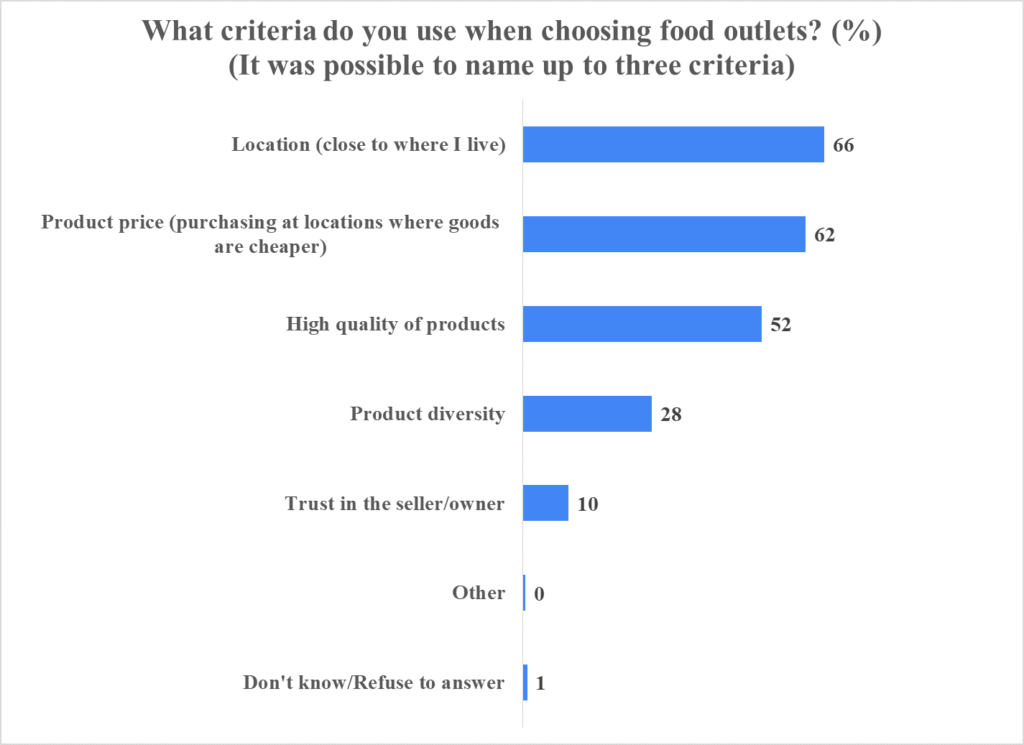
Women consumers choose food retail outlets based on three main criteria: location and proximity to their home (66%), product price (purchasing at locations where goods are cheaper) (62%), and high quality of product (52%). Product diversity is prioritized by 28% of respondents, while trust in the seller/owner is named by 10% (Figure 1).
Figure 1.
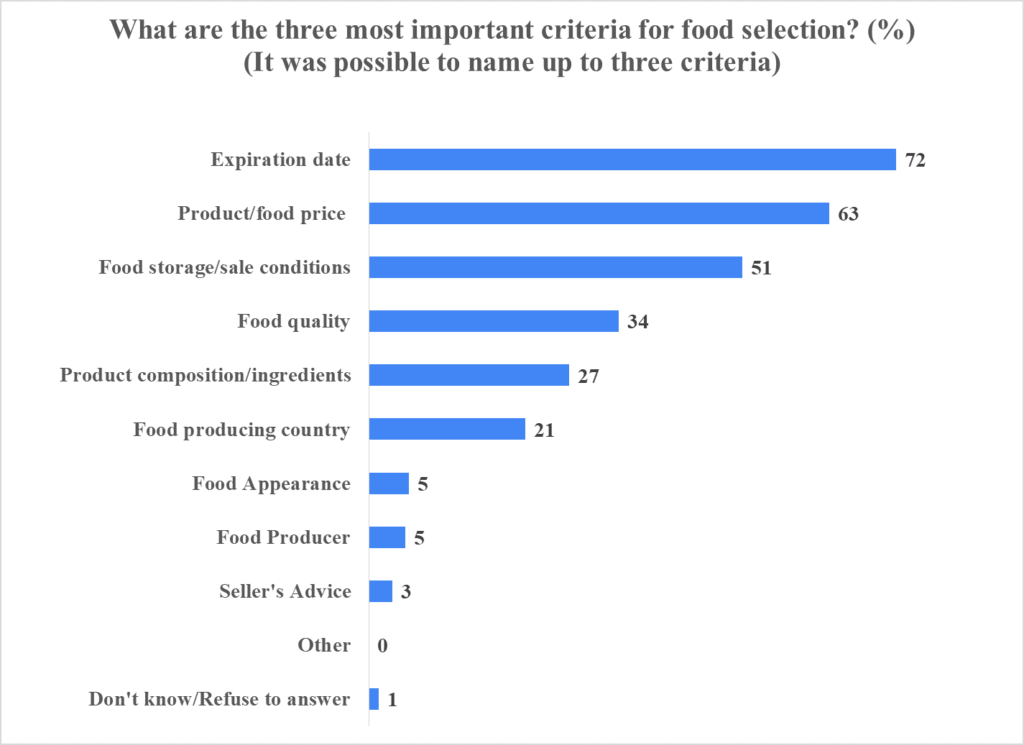
As for criteria for selecting food products, respondents identified the following: expiration date (72%), product/food price (63%), and food storage/sales conditions, such as hygiene and temperature (51%). In addition to these three main criteria, respondents also mentioned food quality (34%), product composition/ingredients (27%), and the country of origin of the product (21%) (Figure 2).
Figure 2.
Sources and Accessibility of Information
Within the scope of the study, respondents were asked about food control institutions. The vast majority of those surveyed had heard of the National Food Agency (98%). They were also aware of Georgian legislation related to food safety (80%). However, awareness of the Competition and Consumer Agency is significantly lower (58%).
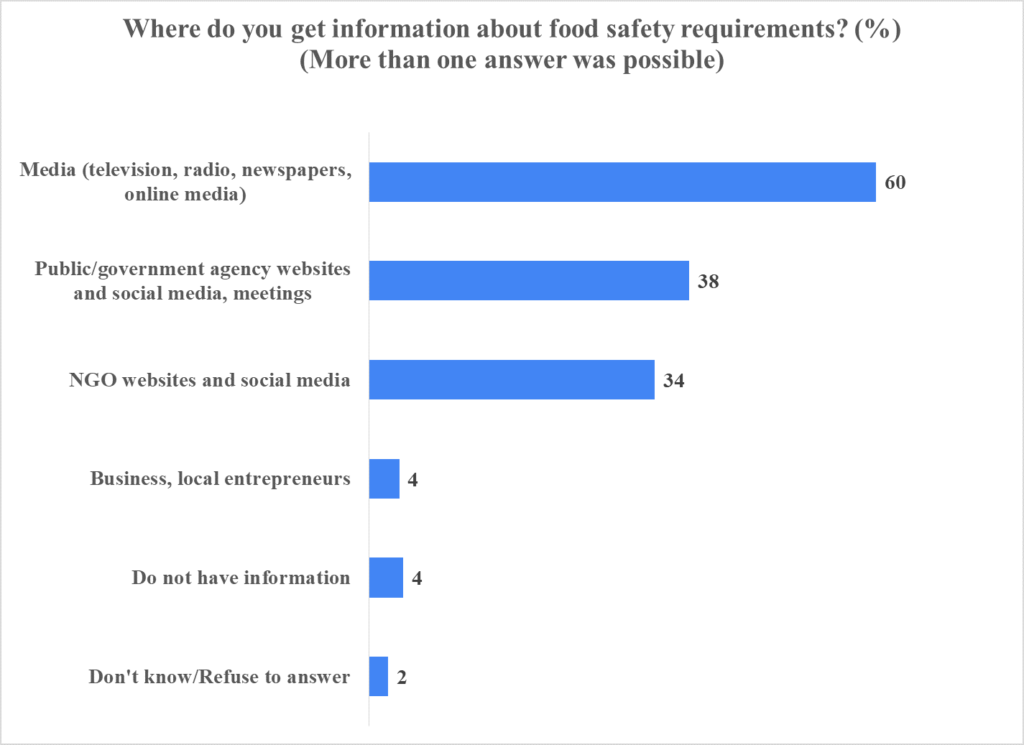
Citizens identify the media (television, radio, newspapers, and online media) as the main source of information related to food safety requirements (60%). In addition, a substantial portion of respondents (38%) use official websites and social media pages of public and state institutions to obtain information. This result indicates that communication produced by state structures does reach part of the public, though its scale and effectiveness is lower compared to the influence of the media. About one-third of respondents (34%) name non-governmental organizations’ resources as a source of information. This data shows that the potential of the civil sector in consumer education and awareness-raising is not being sufficiently utilized (Figure 3).
Figure 3.
Practices of Responding to Violations and Perceptions of Responsibility
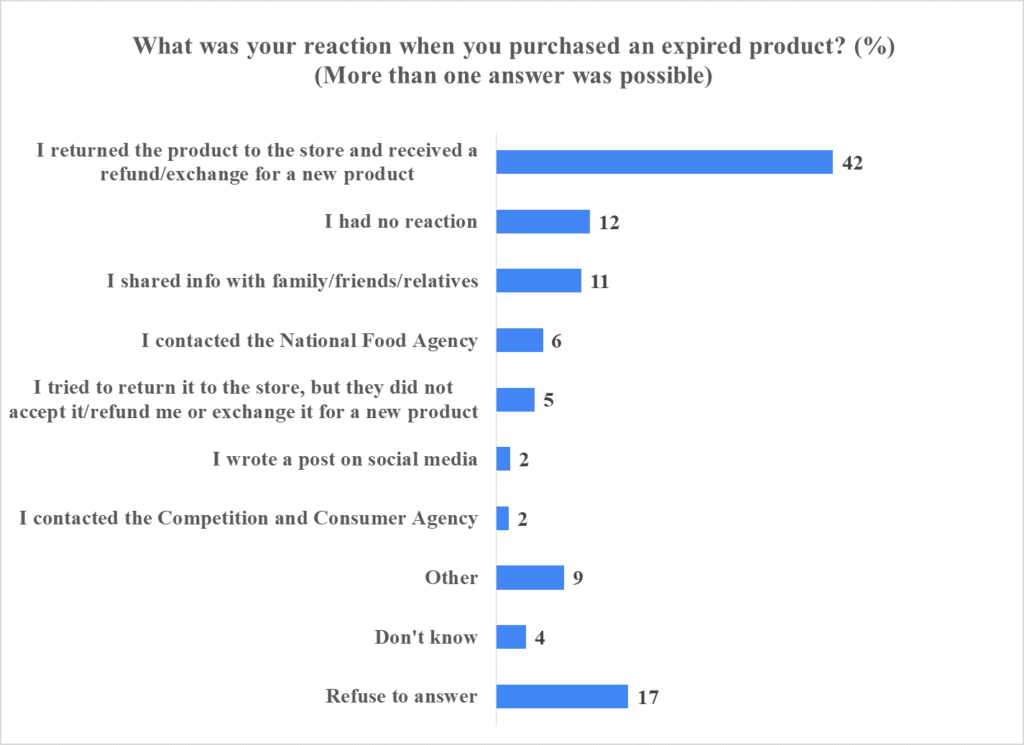
Notably, in response to the question, whether respondents have purchased an expired product during the past year, one-third (33%) answered positively. When asked about their reaction after purchasing an expired product, 42% stated that they returned the product to the store and received a refund or exchanged it for a new product. Twelve percent reported that they had no reaction at all, while 11% shared the information with family members, friends, or acquaintances. Only 6% contacted the National Food Agency, and just 2% contacted the Competition and Consumer Agency (Figure 4).
Figure 4.
However, this does not mean that consumers are unaware of their responsibility or do not know which institution to contact in the event of a violation. Eighty-eight percent of respondents believe that in case of a violation, it is the consumer’s responsibility to contact the National Food Agency.
Future Steps
It can be assumed that civic engagement within the consumer protection system is low because citizens have limited trust in the legal mechanisms for protecting consumer rights. This lack of trust creates a self-restricting mechanism: citizens avoid official institutions, which in turn prevents effective state response. Such a situation complicates the functioning of legal mechanisms and reduces the possibility of a fair and competitive market.
These trends point to systemic challenges that require targeted informational and educational interventions. Consumer protection policy should move beyond formal standards toward real, effective, and citizen-oriented mechanisms. Particular attention should be paid to strengthening women’s awareness and trust, as their engagement is one of the key prerequisites for market transparency and a fair economic environment.
About the Research
This research was conducted within the framework of a joint initiative of CRRC-Georgia and UN Women, aimed at strengthening civil society research capacities. The study was carried out in August 2025 by Marika Vacharidze, a representative of the organization Bright Future. A total of 220 women consumers were surveyed in the Imereti region.
The views expressed in this blog belong solely to its author and may not reflect the official positions of UN Women or CRRC-Georgia.